
Prometheus and Christ
Christian philosophy of technology from Friedrich Dessauer to Peter Thiel

A dark view of material progress as a disintegrating force arose in twentieth-century continental philosophy. The bond between optimism and technology was severed. From the Kulturkritik current of thought to the anti-technocratic fervor of Jacques Ellul, from Heidegger’s reflections on das Gestell to the Frankfurt School’s denunciation of Technik as the path to Auschwitz, Western thought turned against technology.
Christian thought absorbed this dark view, especially in Germany. Technology was the antithesis of life, so maintained the German philosophers before the First World War. In the 1930s Ernst Jünger interpreted technology as an unstoppable force, driven by the imperative of total mobilization, bringing us not only closer to catastrophe, but also summoning a new form of totalitarian state, the only form able to wield the power of technology1. His brother, Friedrich Georg, in Die Perfektion der Technik, warned that technology would exhaust all resources, reduce leisure, and destroy the economy2. This book influenced Heidegger, who would see technology, in his obscure language, as a new way of transforming everything into den Bestand, a resource to be exploited.
That among this overwhelming pessimism appeared the thought of Friedrich Dessauer is all the more striking. He was a polymath — detractors would say dilettante — an engineer and a scientist. Born in 1881, he was 18 when, after learning of Röntgen’s discoveries, he built his own X-ray apparatus. Years later he founded a company manufacturing X-ray machines. A devout Catholic, he was banned from public speaking by the Nazis and imprisoned.
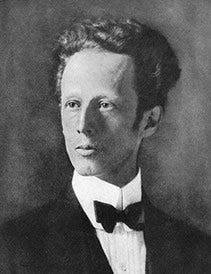
Technology, he argued, is the continuation of God’s creation. Its primary character is service to all humanity, reshaping the world to make it more hospitable to the soul by unlocking the abundance of wealth in nature. Technology does not crush the spiritual values, as many claimed before and after him, and progress does not devour liberty, as the Catholic writer Georges Bernanos warned after the Second World War. “World where technology wins is lost to freedom,” he wrote in La France contre les robots. For Dessauer, on the contrary, technology expands the freedom of man.
Against the prevailing mood toward technology, focused on the hidden and overt dangers of progress, Dessauer held that technology has a religious meaning. Technology traces new trajectories of Creation. The mind of an engineer is a place where man encounters ideas that expand the work of God. The opportunity to participate in this process is a privilege for the Christian.
The flow of ideas becomes technology which, in turn, molds the environment and transforms nature. An unwelcoming world, riddled with dangers and subjugating man to scarcity, is reshaped into a place where the soul can develop its moral force, without succumbing to the brutal necessities of Malthusian survival. Building out this new, higher and more noble environment is the meaning of technology. Its progress becomes the condition of possibility of a Christian life. After the death and Resurrection of Christ, technology is the greatest event in history, argues Dessauer. It has released man from the bondage of animal dependency and set his soul free. It is the means bestowed upon man by God, and man has to respond to the calling of Genesis.
Against the climate of opinion in his time, Dessauer wanted to stress that technology cannot be reduced to ‘instrumental reason’ or to a ‘dehumanizing’ system absorbing every sphere of life. It builds a higher environment — a world beyond Malthusian pressures — a necessary condition for culture.
Technology brings about a new, humanized environment, but also provokes new moral problems. Dessauer insists that the West’s tendency to self-flagellate is one of the main obstacles to confronting them. This penchant for excessive self-criticism, contrary to Christianity, paralyzes moral judgment at the very moment when it is most needed and blinds the West to what Dessauer considers the essence of technology: service. Technical work — between inventors and engineers who help each other, between those who build technology and those who use it — resembles, to strike a Franciscan tone, a mutual pact between ‘unknown brothers’.
Despite this moral dimension, engineers are absent from the ruling classes and socially undervalued. Moreover, even as society benefits from technological progress, most remain industrially illiterate. The attitude of Western societies to engineers builds resentment in them, as they feel their efforts aren’t respected as they should be. While Dessauer grants engineers a privileged position, he warns against some inclinations of their minds. They show aversion to fields where their type of thinking cannot be applied; they overextend technical standards to domains where those aren’t suitable and fall into excessive specialization.
Dessauer fought a two-front war: against those who conceived technology as an adversary to Christian life and culture, and against those who treated it as a merely neutral set of instruments, dissociated from the moral dimension of life. On both counts, Christian technological optimism was the losing side throughout the twentieth century.
*
Romano Guardini did not recognize the metaphysical task that Dessauer saw concretized in Technik: the development of Creation. While he employed the arguments assembled by thinkers of the Lebensphilosophie current, he didn’t arrive at total rejection. For Guardini, a Christian must be of his times and face both the dangers created by technology and the opportunities it reveals.
Guardini was one of the most important theologians of the twentieth century. He shaped a whole generation of German Catholics between the wars and was a crucial figure leading to the Second Vatican Council.
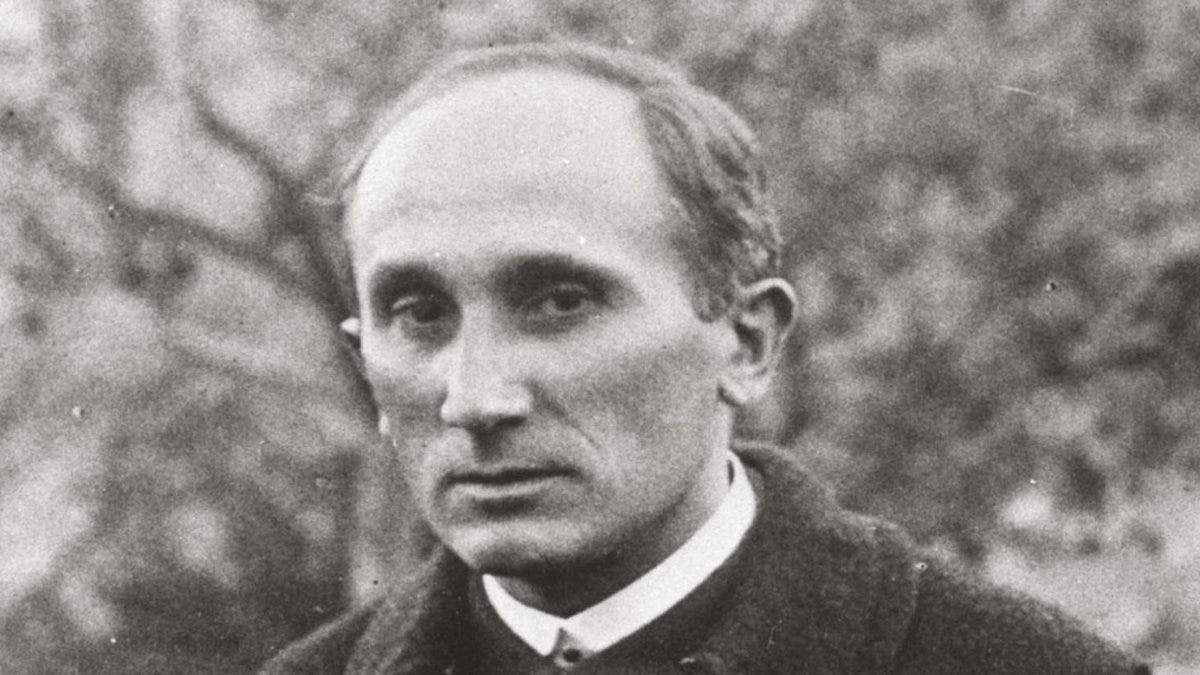
In his writings and letters, Guardini was clear about the vantage point from which he judged history. This period was an interregnum, a middle ground, where one world faded away and the flow of events slowly outlined the contours of a new one. His sense of living in between shaped his ambivalence toward technology. He was of two minds: one nostalgic for what had passed before his eyes, the other alert to the scale of the changes ahead. The Catholic stance is not to mourn what has passed and reject the present, but rather, in line with Toynbee, to see the new times as a challenge and prepare a response.
The Faustian view of technology wasn’t as dominant in German culture as we might assume. Guardini preferred a static world; Heidegger is another case in point - for him, Faust would be someone who strives to subjugate the world to a technological system. The same could be said about F.G. Jünger.
The major weakness of Guardini’s reflection is what Peter Thiel would later call edenism. Technology overwhelms our natural environment, Guardini claimed, by separating man from the world through artificial creations. His ideal — like that of Heidegger, his longtime correspondent and intellectual sparring partner — seems to be a sort of rustic humanism. The pace of the industrial societies dissolves our ability to contemplate and disturbs the natural rhythm of our relation to our surroundings. On this count, Guardini is an unreconstructed romantic.
The fading world differed from the new one in its self-limiting nature. Modernity has lost all measure. This echoes Heidegger’s accusation of Gigantismus. Progress becomes a synonym for excess, and growth means hypertrophy, eroding the constraints inherent in the past. Guardini pinpoints the exact period when the world was transformed and lost the sense of limits: between 1830 and 1870. The spread of the industrial revolution and the consolidation of its gains across Western Europe represented for him a watershed moment. What Guardini’s pessimism obscures is what for Dessauer constituted the moral dimension of technology: the fact of progress lifting millions out of poverty, curing diseases, reducing hardship, and forging new ways of cultural work and interaction.
Edenism is anti-Faustian, and the most anti-Faustian passages of Guardini’s work are present in Letters from Lake Como. Walks through valleys in Northern Italy fill him with sorrow, as the ordered culture of villas is threatened by the growth of industrial civilization. Lake Como becomes a symbol of a certain mode of being, of rustic humanism where man does not shape nature through the violence of his instruments. He feared that South of Italy will soon be devastated as well. That the underdeveloped South Guardini romanticized was a world not of dolce vita but of what Banfield called amoral familialism did not trouble his vision.
Despite his edenism, Guardini remains clear on one point: the coming changes will be profound, and Christians can’t turn their backs on them. They have to immerse themselves in the transformations of the modern age. There is no room for defeatism or the Benedict Option. To Guardini, the defensive Scrutonian instinct to safeguard what is fragile would be misguided; the German theologian advises becoming part of the future and redirecting it from within. Science and technology have become possible because of Christianity. It supplied the sense of trust in life that opened the paths of experimentation and invention, and so what follows can’t be foreign to the core of Christianity. Destruction of the old order through technological dynamism means only that a new form of civilization will rise, and Christianity needs to exert its influence over it. At the same time, Guardini recognizes that there is something demonic about technology. It grants great power and pushes life to the edge of constant danger.
Guardini didn’t see technology as essential to Christianity, like Dessauer did. On the other hand, the combination of ambiguity and openness to the technological future differentiates him from other Christian thinkers. While the majority landed somewhere between Bernanos, Ellul, and Heidegger in their criticism, he saw technological progress as a challenge that Christianity must respond to.
Shy of definite solutions, he speculated that a new ‘global feeling’ was flowing through the world. Guardini imagined a ‘utopia’ — this is the word he uses — where a council of world intellectuals would survey the problems of modernity and deliver objective solutions. Many great ideas, he cautioned, start as utopias. This one-world impulse — from Bertrand Russell to the AI safety movement — would prove to be the central temptation that Thiel’s political theology defines itself against.
Guardini was an edenist, but simultaneously aware that retreat isn’t a response to the challenge of the modern world.
*
Guardini’s openness to the technological future, despite his ingrained edenism, was rare among Christian thinkers. But it remained an openness without a theology. With Sergio Quinzio — an Italian Catholic philosopher mostly unknown outside his home country — we encounter something more ambitious. His attitude to technology was closer to Dessauer’s than to Guardini’s, but the depth of his biblical vision grants him a place apart.
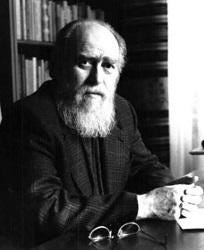
Quinzio rejects an assumption common to both Christian and atheist thinkers: that religion and culture form a separate domain from technology, which operates on them from without. For Dessauer, technology was integrated into Christianity from the beginning. For Guardini, technology was exogenous to religion and culture, although neither should turn its back on it. Quinzio claims that technology acquires eschatological meaning in history.
Quinzio insists, in a manner reminiscent of Dessauer, that Christianity and technology share central orientations. Both value the future more than the present; both are universal in scope, transcending cultural, racial, and social boundaries; both believe in the possibility of salvation; both reveal a heroic, missionary character.
Finally, both are tainted by disappointment. Today, great hopes and high ambitions seem ridiculous; the best that people aim for, warns Quinzio, is peace and safety. This exhaustion inspires in the Italian thinker contempt for what is called ‘civilization’. If its last word is nothing more than the avoidance of fatigue and effort, then fighting for the preservation of this ‘civilization’ is not only futile, but un-Christian. Christianity sides with the living, chooses the young against the old: “The Christian God is the God of the new,” declares the Italian thinker. If Quinzio had lived to see the Europe of today, he would have judged its liberal gerontocracies as profoundly un-Christian.
Quinzio tries to tell us in his books that God can lose, as the hopes of Christianity are ridiculed or rejected as purely symbolic. The problem of modern-day Christianity is the dilution of Christ’s message: things that were supposed to be treated literally are reduced to colorful rhetoric. This dilution has advanced to a point where there is no difference between believing and not believing.
Biblical promises, explains Quinzio, were concrete and material. After the sign of the rainbow appears, God says to Noah, “this is the sign of the covenant that I have established between Me and all flesh that is on the earth.” The promise does not concern spirit; it concerns flesh. In Genesis Abraham is promised numerous descendants, riches, and a happy old age. Even in the vision of Jacob’s ladder, the promise of God is the land and extraordinary fertility.
‘Spiritualizing’ those passages weakens Christianity. But its promise goes beyond material abundance. When Paul attacks those who, having left the path of truth, claim that the resurrection of the dead has already occurred, he criticizes their interpretation of the resurrection in a purely mystical sense.
Quinzio quotes from Paul: ‘The last enemy to be destroyed is death.’ Designating death as the enemy was the radical gesture of Christianity. In the Apocalypse, as Oscar Cullmann stresses in his Immortality of the Soul or Resurrection of the Dead?, death is thrown into the fire. Everything that stands against life — death and sickness — belongs to the realm of sin. This is why Christ, after healings, says: ‘Your sins are forgiven.’ Every healing is a partial resurrection. From this it follows that technology which cures disease or extends life doesn’t merely alleviate suffering. It contests the dominion of death.
Technology can’t be separated from eschatology. The rise of nihilism was inversely proportional to the fulfillment of Christian promises. The only way to roll nihilism back is to return to the ambitions from which Christianity sprang in the first place. The retreat of Christian hope can be neatly mapped onto the retreat of technological optimism.
*
That the progress of technology is fundamental to the promises made by Christianity is the core idea of Peter Thiel. He coined the term ‘edenism’ to designate those who see efforts to accelerate technology as irreconcilable with faith. Like Dessauer, he suggests that technology is something more than a ‘natural ally’ to Christianity. It could be the continuation of Creation, if “we remain open to an eschatological frame in which God works through us in building the kingdom of heaven today, here on Earth.”
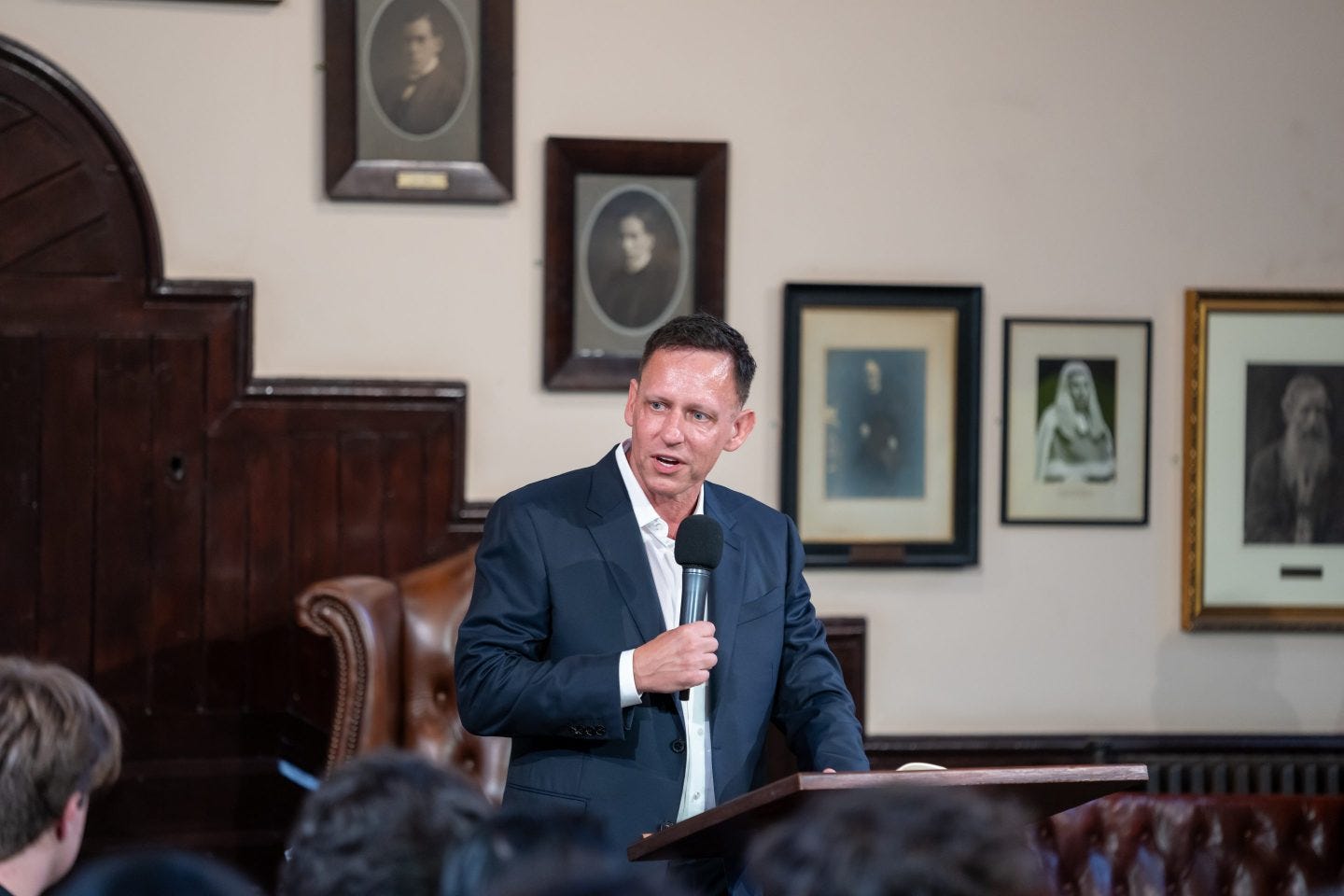
Growth is downstream from technological progress. The expansion of the human population on Earth and the easing of Malthusian pressures were possible only thanks to technology. To this argument, bearing a striking resemblance to Dessauer’s, Thiel adds another concerning the future of democracies or social harmony. Deceleration of growth, the effect of technological stagnation, will erode the win-win logic of Western political systems built around compromise. The spread of zero-sum thinking, the collapse of redistributional mechanisms, and the fight for survival could spell the end of representative democracies in their current form.
Besides the anti-Malthusian, pro-democratic effect that growth stimulated by technology has on the West, Thiel’s recent writings and speeches point to an eschatological dimension. Here his path converges with Quinzio’s. Thiel has been preoccupied with Apocalypse and Antichrist for thirty years, as he revealed in conversation with R.R. Reno. The eschatological tension is already discernible in “The Optimistic Thought Experiment”. For Thiel, Apocalypse and Resurrection belong to the technological and eschatological dimension at the same time.
Thiel’s well-known diagnosis of stagnation develops alongside his ideas on the intellectual blindness of Western elites. The two are connected, since stagnation persists in part because elites are unable to see it. Science is fragmented into niches so specialized that almost no one can recognize whether they are really making progress, or just claiming to do so to collect grants. Financial and state elites allocate capital not on the basis of a vision of a certain future but in the direction indicated by psycho-social bubbles. Society lives in an illusion of ever-accelerating progress as it is drawn further into virtual worlds, masking the fact that the only meaningful progress in recent decades has taken place in information technology. Thiel’s Girardian cut, his version of hermeneutics of suspicion — an attitude adopted in the face of elite deception on the one hand, and against mimetic contagion on the other — would be to ask oneself: what questions are concealed?
“What is truly frightening about the twenty-first century,” wrote Thiel, “is not merely that there exists a dangerous dimension to our time, but rather the unwillingness of the best and brightest to try and make any sense of this larger dimension.” This unwillingness is manifest in the Catholic Church. While Thiel wants us to acquire a certain aptitude for strange, new thoughts, the Church not only remains indifferent to those questions, but has attacked Thiel for bringing them up.
Alberto Melloni, the historian of the Second Vatican Council, reduced Thiel’s Italian conferences on the Apocalypse and the Antichrist to a cover for pushing Palantir onto the Italian government. Paolo Benanti, the Vatican’s expert on AI and a Franciscan friar, attributed to Thiel a belief in authoritarian world government — the very position Thiel explicitly rejects as one pole of the false alternative of “One World or None.” Neither engaged with the central categories of Thiel’s political theology. Melloni mentioned the Antichrist only to discredit Thiel; Benanti didn’t mention the Apocalypse at all3. What Thiel described as elite unwillingness to confront the eschatological dimension of our times, the Church demonstrated in practice.
Technology can be a form in which man continues the work of Creation, and Thiel believes that the promise of resurrection needs to be taken literally. If death is the last enemy, as Paul wrote, and every healing a partial resurrection, as Cullmann argued, then technology that defeats death would be the culmination of the Christian direction imposed on progress. The Dessauer–Quinzio line reaches its extreme point here: technology participates not merely in God’s creation, but in the final victory over death itself. The current period of stagnation, which Thiel denounces in economic, political, social, and geopolitical registers, has eschatological consequences.
If the Christian promise is the world of abundance and, ultimately, of defeating death, then the deceleration of progress in the world of atoms and the narrowing of technological advancement to the world of bits have an unambiguous meaning: stagnation is not merely an economic failure but a religious one. In the parlance of Quinzio, stagnation is the defeat of God. Yet Thiel’s political theology recognizes that technology doesn’t only promise salvation — it also threatens destruction.
The recurring figure of Thiel’s thinking is Scylla and Charybdis. In the Odyssey, there is no middle course; the hero must confront one of the monsters. Thiel always rejects both extreme alternatives, recognizing a narrow path that leads beyond both dangers. Human agency is what makes the narrow path possible. The most often evoked example of this thinking is his take on optimism and pessimism. Both extreme pessimism and extreme optimism converge on apathy. He applies the same logic to Apocalypse. If we believe the Apocalypse is imminent, there is nothing we can do; if we believe it is merely a symbol that will never materialize, there is nothing we will do. The answer isn’t tomorrow, but it also isn’t never.
Technology dialed up the dose of the eschatological in history. Apocalypse is closer than ever. In the secularized language of our age it denotes ‘existential risks’: climate catastrophe, outbreak of a deadly virus, nuclear war or the summoning of AGI4.
Throughout the twentieth century, those existential risks triggered a recurring political response among politicians and intellectuals: one world government. Since humanity endowed itself with the power of self-destruction, it must install a government that will guarantee no actor can ever use this awful force. We saw this line of thinking in Guardini; Thiel traces a whole spectrum of thinkers and politicians, from Bertrand Russell to JFK, who regarded world government as a way to permanently stave off the nuclear Apocalypse. Today, as AGI is seen in many intellectual circles as the most imminent existential threat, some thinkers favor world government. For Thiel, this is the face of the Antichrist: a political order with no outside and no place to run, offering peace and safety at the price of total control.
History is not only a set of events that happen only once, but is full of explosive forces. In the blink of an eye the world can be turned upside down. This kind of vision can induce anxiety in some; however, it seems Thiel’s design is to increase our alertness. There is a narrow path between Apocalypse and the Antichrist. Human will, the greatest of Christian mysteries, can carve out a middle course between extremes. Will this narrow path be a conquest of political will or a result of technological invention? To avoid both Antichrist and Apocalypse, the answer will probably require both.
For more than a hundred years, Christian philosophy of technology has been trying to sort out the relationship between Prometheus and Christ. The Promethean impulse is most visible in Dessauer, Quinzio, and Thiel. Henri de Lubac wrote that it was Christianity that made the Promethean revolt possible. In the pagan world the divine was immutable fate, irreversible destiny; in the Christian world the order of nature is meant to be disturbed.
Prometheanism is not a crisis of faith, but a crisis of hope. Philosophical atheists, Thiel explains, claim that where there is no hope, there is faith, and where there is faith, hope is superfluous. But separating faith from hope suffocates both of them. The technological ambitions of modernity once mapped onto Christian hopes — hopes that the postmodern Church has since abandoned.
Impatience of Christian prometheanists shows in their diagnosis. Thiel’s stagnation thesis is a way of saying that, in the parlance of Quinzio, God is losing. The insistence on human freedom — Thiel’s narrow path — is perhaps the most Promethean element in the Christian philosophy of technology since its beginnings. Christian thought, with rare exceptions, accepted the divorce between optimism and technology and retreated into edenism, spiritualization, or indifference. That divorce between Christian promise and technological ambition was a catastrophe. Not only for progress, but for Christianity itself. Thiel pushes this thesis further: it spells catastrophe not only for Christianity, but for the world itself.
History proved him wrong, as it was the United States that was the most technologically advanced great power during the Second World War. A democracy under arms, it became the freedom forge and was able to build the bomb that Hitler's Germany could not.
His observations show how misconceived his notion of technology was. It means doing more with less, and in the twentieth century it unlocked more resources than we thought available and gave us more leisure. F.G. Jünger's points on the economy are equally misplaced, as the productivity stimulated by technology is the engine of growth.
Benanti claims, inaccurately, that Thiel's idea of time is cyclical, tragic, and pagan. In his second conversation with Tyler Cowen, Thiel says clearly that everything happens only once. His thinking about founding companies reveals the same logic: no one will build another Google or another Facebook; those moments happen only once in business, like any other event in history. "Something of somewhere is probably nothing of nowhere," he often repeated, stressing the singular and inimitable character of every important figure or company.
Then there is the question of timing of Thiel’s intervention. Why tour with his conferences now, and not, let’s say, in 2008, after the financial crisis? I see three reasons for it: erosion of American credibility and it’s consequence, that is nuclear proliferation; Covid and the regulatory mimetism of elites; rising fears around AGI. Let’s consider them:
1) The first is the possibility of nuclear proliferation. American decadence was on full display in recent years: the evacuation from Afghanistan, the inability to deal with the Houthis, the lack of results in the proxy war in Ukraine and Iran (together with embarrassingly rapid depletion of American munitions in both cases). As the Secretary of Defense admitted, in every war game the US loses to China. The American empire no longer commands the assets to cover its liabilities across the world. Allies recognize that their survival can’t depend on an overstretched Washington, and are discussing independent deterrence capabilities. We have found ourselves on the brink of a new era of nuclear proliferation — which is to say, the Apocalypse has drawn closer.
2) The second is COVID. In Thiel’s reading, the pandemic originated from a leak of a biological weapon created by the CCP. What it demonstrated, however, was that governments around the world move like a school of bluefish, their policies replicating through mimetic contagion. Robin Hanson was the most incisive in recognizing this: the lockdowns were an extreme example of how an availability cascade can trigger a tide of imitation sweeping across the developed and developing world. The mimetic mechanism matters because it reveals how a world government might arrive — not through a treaty or a conquest, but through cascading imitation that eliminates all alternatives.
3) The third is AGI. Thiel position on AI is that it resembles the internet at the end of the nineties. It falls short of a revolution, but can't be reduced to a blip either. At any rate, it won’t trigger Apocalypse. But the slogan of the Antichrist is ‘peace and safety.’ The fears spread by the Bay Area rationalists, the millenarian trembling palpable in Yudkowsky’s writing, Bostrom’s plans for world government to contain AI — these fuel anxiety. What counts is not the state of advancement of a given technology, but the mimetic cascade of fear it triggers. AGI may not be the Apocalypse, but the panic surrounding it could summon the Antichrist.